|
|
|
| BAS Home | Ozone | SCAR | Turbidity |
|
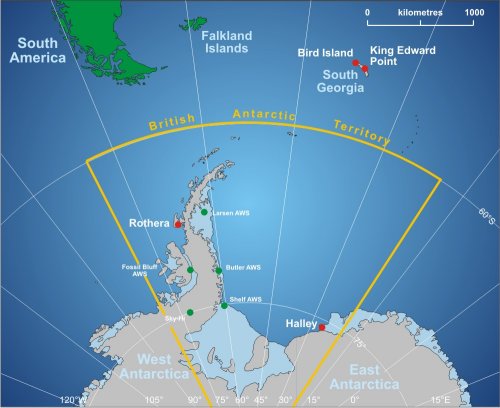
Meteorology and Ozone Monitoring (MOM) is part of the Long Term Monitoring and Survey work undertaken by BAS into the atmospheric environment. Meteorological data is continuously collected at each of the BAS stations and ozone measurements are routinely collected at Rothera and Halley. The Halley records first began during the International Geophysical year (IGY) in 1957/8. It is by using these long term, continuous measurements, that BAS has been able to monitor changes in the atmosphere. This has led to discoveries such as the hole in the Ozone layer, the warming of the Antarctic peninsula region and more recently the apparent warming in the mid-troposphere. Collecting the data requires some MOM staff to overwinter at both Halley and Rothera stations. They take instrument readings, launch radiosonde balloons and collect air and snow samples. Meteorology Meteorological observations are made regularly throughout
the day at Halley and Rothera. Surface temperature, humidity, sunshine,
pressure, wind speed and direction are largely measured by automated instruments
but an observer is needed to estimate the visibility and the amount, type
and height of clouds, although automatic instruments are being introduced.
The observer also needs to keep note of the weather: rain, snow, fog,
gale etc. as well as more unusual phenomena: diamond dust, halos, mirages
and the aurora australis.
All the observations are expressed in a numeric code and sent via geostationary satellites to meteorological centres, where they join thousands of other observations from all over the world. The real-time data are processed by super-computers and used to forecast the weather and are archived and used for further climatic research. For more information see the BAS meteorology pages Radiosondes Meteorological balloons are launched regularly from
both Halley and Rothera. They carry a radiosonde which signals back
the temperature, humidity and pressure to an altitude of over 20 km,
with wind speed and direction found by tracking the package with GPS
sensors.
Data from these radiosondes are used in computer models to give the latest weather forecasts and are used for climate research. Recent studies of the data from Halley and several other Antarctic stations have shown there to be a significant warming of the mid-troposphere in the wintertime during the last 30 years. Ozone Ozone in the stratosphere is measured by instruments
based at Halley and Rothera. The measurements at Halley began in the
late 1950s and the same type of instrument, the Dobson spectrophotometer,
is still used today:
The long data record from Halley enabled BAS scientists to first notice the depleting spring time ozone values over the station which began in the 1980s. This later became known as the ozone hole. For current ozone information see the BAS ozone pages Air and snow sampling
Air samples and precipitation samples are collected by MOM as part of several
global monitoring programmes. Air samples, taken weekly at Halley, keep
a record of the changing levels of greenhouse gases in one of the most pristine
areas of the world. Levels of CO2, from this clean environment are useful
as a background reference and show how levels of this gas are increasing
rapidly.
|