CNHS Grantchester Meadows Survey
Grantchester Meadows
2016 We returned to the area in 2016. We recorded in the three monads TL4456, TL4356 and TL4355 generally and Skaters Meadow, Lamppost Meadow (in two monads) and Little Fenn (also in two monads) specifically. As before, the normal meeting point for the walks was at the Grantchester Meadows car park, off the junction between Barton and Newnham Road in Cambridge (map reference 440570), with Grantchester church (TL433554) as an alternate.
November 19 With the Met Office forecasting the first big storm of the autumn on the scheduled date, the meeting was brought forward a day. The weather was overcast, generally cool and calm, though there were a few drops of light rain at one time. The visit was to focus on bryophytes of the survey area, but Mark Hill suggested that as the area was adequately recorded it would be more useful to head straight to Grantchester and record in two monads to the west of the village. Having given late comers an extra fifteen minutes we headed off and began recording some common pavement mosses once we entered the square. We headed west and across the M11 bridge, where we found our first notable species, Bryum algovicum, a rare(ish) moss that was growing on gravel at the side of the bridge. Heading south Mark spotted a coppiced Ash growing on the parish boundary, at the base of which was Neckera complanata, a moss more frequently found in older woodland. A copse further along the boundary was rather disappointing, but once we crossed into our second monad we found a few arable bryophytes not seen earlier. The river gave us our first liverworts, then a small plantation, by the M11 and the river, had a sufficiently damp environment to support epiphytes. Here Jonathan found Cololejeunea minutissima, a tiny liverwort that has enormously expanded its range over the last decade. By now it was getting a bit gloomy, but a few more species were added as we crossed the motorway, then it was a brisk walk back to Newnham.
October 23 There was fine autumn weather for our fungal visit, however the autumn had been dry and relatively warm, so few fungi had emerged. We started by looking at Skaters Meadow, but there was not much to see. The first fungus showed its presence by the damage it was doing to Ash trees along the fence line - Chalara fraxinea (Ash dieback) had struck. The far end of the meadow had many Harlequin ladybirds and several types of mildew, but it wasn't until we were nearly back at our starting point that we found some Coprinus, a Psathyrella and a Myxomycyte. Continuing towards Grantchester meadows along the footpath we noticed a fungus on some tree roots, and moving round the tree found considerable growth of Perenipora fraxinea. The meadows had several more mildews, a rather nice Hawthorn Shieldbug, and Phelinus pomeracea on some Blackthorn. The growth of Floating Water Pennywort in the River Cam was remarkable, nearly closing the river in places. The churchyard in Grantchester had several new fungi, though they took some finding, the easiest to identify being Stropharia caerulea. Other notables in the churchyard were a Hornet, a rather hairy wasp, signs of chafers, some butterflies and many more Harlequin ladybirds. Returning via the copse at the end of Grantchester Meadows the remaining two noted Horse Chestnut leaf miner, Trametes gibbosa and Sycamore Tar Spot. An old willow near the footpath had collapsed further over the summer, and a mushroom at its base appeared close to Agrocybe cylindricae. An oak tree had Knopper Gall, and a Walnut had a gall Aceria erinea and leaf spot Ophiognomonia leptostyla. Altogether we recorded around 20 species of fungus.
September 25 Our lichen excursion went to a new location for the surveys, Cambridge Lakes golf course, which is in one of the three monads that has little other public access. We started by looking at the brick paving outside the club house, where Jonathan had estimated there might be a dozen species - once our expert, Mark Powell, arrived this proved close, as 11 were found. We progressed slowly round the margins of the course, with Mark showing us the different broad groupings of lichen. Mark Hill in the meantime was recording bryophytes (all mosses). Thanks to the expertise of Mark P, two lichen species new to the county were found, but these were probably previously un-recorded as opposed to not being present. Unusually for our excursions we were able to finish with a welcome cup of tea and cake in the club house. Before departing Jonathan had a further wander round the car-park and found the dog-lichen that he had been looking for without success around the course.
August 28 A small group gathered at Grantchester Church on another sultry summer day, with the threat of showers from the Met Office. We started with a look round the churchyard, mostly re-finding species from the 2006 survey, but adding Burnet Saxifrage. We watched a black & yellow striped insect on one grave, possibly a sawfly. Leaving the churchyard we walked up High Street to Coton Road, where there was an Amaranth (A. powellii) growing on the road verge. There were no other exotic species, so we started a circuit towards Grantchester Mill, stopping to inspect a muck heap, which had some giant Cockspur and Yellow Bristle Grass, as well as Wild and Cultivated Oats. A dying Leveret caught our attention, but we let nature take its course. With the rain now very close we did a final circuit of the charity carpark, and the rain brought an end to the excursion, though Jonathan did continue to Little Fenn and back, adding a few species but nothing of significance.
August 3 The final evening walk was on a fine, breezy August day and for once it was completely dry. The small group walked from Grantchester Meadows along the now dry drainage ditch, and then along the river to Little Fenn. New flowers were few and far between, but we saw a bright Comma butterfly sunning itself near the river bank. We added 11 species to the Little Fenn list, despite my leaving its record sheet on the printer. The return leg along the permissive footpath added rather more species, a notable find being Bromus secalinus on the edge of a wheat field in Grantchester. There was also a single plant of Kickxia spuria further along the margin. An unusual sighting was a Cinnabar Moth caterpillar feeding on Groundsel.
June 30 June was a generally wet month and today was no exception, though at least the rain was mostly nuisance value. Three intrepid botanists met at Grantchester church, and quickly decided that our previous recording had missed quite a few obvious species. We initially looked closely at a Pearlwort and a Ladies Mantle, then wandered around the churchyard. An exciting find on a recent grave was Least Pepperwort, last seen in the county in 1989. From the churchyard we continued through the village and whilst we continued adding to the species list, recently mown verges reduced the interest. Two of the trio had to leave once we returned to the Mill Way, leaving the recorder to check the road verges towards Brasley Bridge and then make a quick circuit through the Meadows to Little Fenn and back. The Meadow Barley was up in the Meadows, and Hop Trefoil was a nice addition to their species list. A quick stop on the way back to Cambridge showed that Tubular Water-dropwort was still present in the old drainage ditch nearest to Newnham.
June 1 It was cold (11°C), overcast and damp with occasional drizzle for the first of our summer evening walks. The stalwart few began at Skaters Meadow, where the Marsh Marigold was still in flower, although now often hidden by the lush and still growing vegetation. We discussed some points of identification, including that of Beaked Hawksbeard, which conveniently was sufficiently mature to show the beaked achenes. There were many orchids in flower, with some debate about species, though later reference to an id book (it being too wet to be worth bringing any), suggested Early Marsh, with at least one plant showing a much darker top and therefore probably the hybrid with Southern Marsh. Lamppost Meadow had a few additions, but the ditch was deemed to be still too wet to cross. The now dwindling number walked along the river to Little Fenn, then more quickly back along the footpath, where we paused to look at Lime Nail Gall. Our bird total was reasonably respectable, but we decided that two Swallows didn't yet make a summer.
May 1 The cold days of April were on the way out, and we had relatively mild conditions, although a few spots of rain fell towards the end of the day. Once again Skaters Meadow was still quite wet, though many plants were starting to grow. We looked at some of the common plants, seeing sedges (with edges) and round rushes. One sedge looked a bit different to Jonathan, so it was taken home and checked. It turned out to be Common Sedge Carex nigra, which had not been seen here before. There were a lot of seven spot ladybirds on the drier grassland and Peter spotted a pair of Red-legged Partridge. The lamppost meadow was still too wet to explore, and we initially continued along the first drainage ditch, finding Water Crowfoot growing well. We continued along the river to the church, though did not find anything very notable, and then back along a different route, which was botanically poor, but did give us a packet of chocolate hobnobs! Our bird list was far longer than usual thanks to Olwen and we also found a mushroom, which given the date, smell and size could only be St George's Mushroom.
April 3 The Met Office promised a warm sunny afternoon with the highest temperatures of the year, and whilst it started warm enough at 2pm, it became steadily cooler. It was spring, but there were only a few new flowers out, however there were bees and butterflies on the wing. We started at the churchyard where we found a good number of plants to add to our species list. One plant we discussed was Greater Celandine Chelidonium majus, with bright orange latex, in contrast to Welsh Poppy Meconopsis cambrica with white latex. We had the county Bee recorder with us, and she identified several interesting species, including the Hairy-footed Flower Bee and its cuckoo, as well as a bee with an epiphytic fly on its abdomen. From there we walked through the village to the permissive footpath that runs alongside Grantchester Road. This was a little disappointing in terms of flowers, but we did see a couple of galls. Skaters Meadow was still very much a marsh in its lower reaches and Lamppost Meadow was even wetter. The meadows along the river were lacking in much of interest, though we did see the Little Egret. The Ransoms Allium ursinum was still present in the copse at the end of the meadows. There were a lot of 7-spot ladybirds around, comfortably exceeding the number noted in January.
March 6 Although this visit was at the start of spring, winter was very much in the air with passing light showers of rain and soft hail. We met at Skaters Meadow, which had changed little since our first visit, though we did add a few plant species from the higher ground near the car park. Lamppost Meadow was still wet and we walked through quite quickly. We took the upper route to Grantchester, and progress was again fairly quick along the impoverished meadows, apart from a stop to check the identity of a flowering Prunus in a hedge, which we decided matched Blackthorn most closely. Jonathan suggested walking through and around the village before moving on to the churchyard. The party was particularly instructed to look for Whitlow Grass, as Jonathan had found the rarely recorded Erophila glabrescens in Girton earlier in the week, and suspected that it might be more widespread than previously thought. Alan Leslie then spotted the white flowers of the species on a verge and invited Jonathan to check it out. Going down on hands and knees next to Nutters Close fortunately didn't attract too much attention, but did reveal the shiny hairless leaves of the rare species at its 2nd confirmed location in the county. Hunting in a garage area Jonathan then found the common Erophila verna allowing us to compare the two. Continuing on to the churchyard we passed a vastly over-deepened drainage ditch, with what looked like Duckweed at the bottom, despite comments that it looked like a lobster pot and once in you wouldn't be able to get out Jonathan descended the slope, then tool using like a Chimpanzee selected a long piece of cut scrub to fish out a sample. The churchyard didn't have much new to offer, and indeed the whole route back was rather disappointing. Back at Skaters Meadow, the comment that we hadn't seen a Pheasant got the response well there is one in the Meadow! Overall we did rather better at recording birds than usual, noting 16 species, thanks to a couple of more competent birders than the usual crew of botanists. Our flowering plant list was a little down on January with only 34 in flower.
January 1 Our traditional New Year's Day walk kicked off our visits to the area on the coldest day for over a month. It was still well above freezing, though there was a little residual ice in Skaters Meadow from the overnight ground frost. A brisk wind and overcast skies made it feel cold. The lower meadows were all very wet, making the recommendation to wear wellies completely justified. Most surprising in Skaters Meadow was the Marsh Marigold, which was already in flower, and we also saw a Little Egret at the bottom end, although the majority of the party did not cross the flooded ditch to the bottom. The Lamppost Meadow was also quite wet, so we kept to the top, finding our third plant in flower - White Dead-nettle. Continuing along the river, we found a few more plants in flower, and stopped for lunch above Little Fenn. It was not until we got to Grantchester churchyard that our flowering total really began to go up, with three species of Snowdrop in flower; we also found 68 7-spot Ladybirds on a bench. We continued through the village and back to Newnham along the tarmac path, although with the light fading we made brisker progress. At the end of the day the count was 39 plant species in flower, and totals of 134 vascular plants, three liverworts, six mosses, 12 fungi, one lichen, five insects, nine birds and two mammals.
2006 Our project for 2006 involved monitoring the flora of the meadows from Newnham to Grantchester. We also looked at the ladybirds in the area. The final Grantchester species list, which includes a list of species not recorded and others to look out for, was updated in 2009 August. Altogether we found 340 species, and failed to find 35 previously reported. We designated ten set areas for logging the species: Entrance tracks, ditches, the river, Skaters Meadow, Lamppost Meadow, Newnham meadows, Little Fenn (Water Meadow), High meadows, Grantchester meadows and Grantchester wood. Byron's Pool was added in October, and surveyed in 2007. Only some entries on our list have been verified by the county recorders; a verified list can be supplied on request. The normal meeting point for the walks was at the Grantchester Meadows car park, off the junction between Barton and Newnham Road in Cambridge (map reference 440570), with the Red Lion pub in Grantchester (TL 435556) as an alternate. See Aerial map with streetmap overlay from multimap.com. Note that the tracks can be very muddy in wet weather and Wellington boots are advisable. Occasional visits whilst passing through the area have added additional species to the list, and the ease with which some were added suggests that even with our very thorough survey some 10 - 15% of species were missed.
Area map from streetmap.co.uk
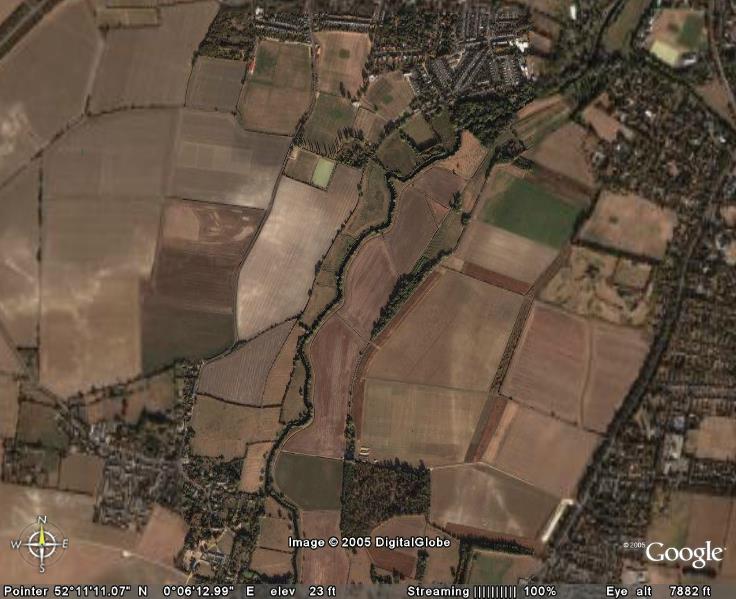
Aerial map from Google Earth
Aerial map with streetmap overlay from multimap.com
Part
of the area is a City Wildlife Site,
which is surveyed by the Wildlife Trust from time to time, primarily for indicator species.
These surveys are usually carried out over one or two days every seven years by
one or two people and do not provide a comprehensive list of what grows on the
site. Information from these surveys has been incorporated into our list
of species to look for. The CWS consists of three meadows beside or close
to the River Cam, and covering approximately 4.6ha.
It is divided into three fields.
Southwestern field
(2nd Lamp-post meadow)
The
main field has a broad division between damp neutral grassland to the north with
drier neutral grassland to the south and west.
The sward is dominated by coarse mesotrophic grasses, particularly False
Oat-grass Arrenatherum elatius, with a mean height of around 100cm.
Creeping Thistle Cirsium arvense is frequent, and abundant in places, and Common
Nettle Urtica dioica is locally
abundant. There are few grassland
indicator species; Hairy Sedge Carex hirta
was locally frequent in the drier grassland.
The height of the sward may have caused under-recording, however.
Two
internal drains cross the site; both were dry or merely damp at the time of the
survey. The northwestern drain runs
parallel to the northwestern boundary. It
is dominated by tall riparian plants, such as Greater Pond-sedge Carex
riparia and Reed Sweet-gras Glyceria
maxima, and by plants of flushes, such as Creeping Buttercup Ranunculus repens and Creeping Bent Agrostis stolonifera. The
southern drain runs east from the northwestern drain.
It is dominated by sedges Carex spp.
(with locally abundant Lesser Pond-sedge Carex
acutiformis) and Creeping Bent.
There
are occasional individual trees and shrubs.
The southwestern boundary is marked by a line of tall (15-20m) Ash Fraxinus
excelsior, which joins a gappy hedge of mostly Hawthorn Crataegus
monogyna and Blackthorn Prunus spinosa
along the southern boundary by the river.
The riverbank on the southeast side is fenced out, and is dominated by
dense Common Nettle and Cleavers Galium
aparine, with three Salix (S. alba, S. fragilis, or hybrids). The northeastern
boundary borders the central field and has seven surviving White Willow Salix
alba and Crack Willow S. fragilis pollards
which have recently been repollarded. In
addition there are three 20-25m Ash. The
northwestern boundary is a gappy hedge of mostly English Elm Ulmus procera, and is heavily shaded by several very large Ash
on the other side of the Grantchester footpath.
A
corral in the north corner contained typical rank vegetation of disturbed and
nutrient rich ground, especially Common Nettle and thistles Cirsium
spp.
Central field (Skaters’
Meadow)
This
field is the Wildlife Trust reserve called Skaters’ Meadow.
It has high quality damp to wet neutral grassland.
There are many grassland indicator species.
Common Spike-rush Eleocharis
palustris is abundant, and Marsh Marigold Caltha
palustris, Ragged Robin Lychnis
flos-cuculi and Hairy Sedge Carex
hirta are frequent. Early
Marsh-orchid Dactylorhiza incarnata is
frequent in a band roughly parallel to the northwestern and northeastern
boundaries. At the time of the
survey mean sward height was generally around 50cm.
Coarse mesotrophic grasses and other rank vegetation such as Anthriscus
sylvestris only dominate in the drier areas 5-10m from the boundaries,
particularly at the northwestern side (the highest and driest part of the field)
and the southwestern side (where tree works have disturbed the sward) and in the
corral in the west corner.
Mature
Limes Tilia x europaea in the adjacent
property shade the southeastern margin. The
replanted northeastern hedge of Ash, Hawthorn, Dog Rose Rosa canina agg.
and Bramble Rubus fruticosus agg. etc.
is gappy.
Northeastern field
Permission
for access in 2005 was not obtained from the owners and this field was not
surveyed.
Site
assessment
The
site qualifies under City Wildlife Site criteria for neutral grassland
(criterion 2.10a), pollard willows (criterion 2.7), and as part of the riparian
habitat in the River Cam valley (2.12a). It
also deserves consideration under criteria for Greater Pond-sedge Carex
riparia swamp (criterion 2.11ai), Lesser Pond-sedge Carex
acutiformis swamp (criterion 2.11aii), hydroseral zonation (criterion
2.11d), and two or more fen types (criterion 2.11e). Additionally, this site has
previously qualified as a County Wildlife Site (CWS) for the damp neutral
grassland interest of the central field (number of neutral grassland indicator
species and possibly for NVC community MG8), although on the basis of the
present survey it does not quite have sufficient indicator species.
Grantchester Meadows through the seasons
2006 October 15: A large group, led by John Holden, Helene Davies and Lucy Evans, and including Jonathan, David, Henry, Lily [who found lots of fungi], Steve and Toby. The final survey concentrated on fungi, however a few plants were also added to the list. After lunch at the Red Lion we progressed to the meadows and wood near Grantchester. Finds ranged from tiny Fairy's bonnets (Coprinus disseminatus) to a large Horse mushroom (Agaricus arvensis) nearly has big as Lily who found it. Moving on to Byron's Pool, Toby found a fungus beetle Endomychus coccineus. Several new fungi for this area were found and we also found the rare Earth stars Geastrum coronatum and Geastrum fornicatum.
2006 September 24: Jonathan, Monica and Steve. The weather had been mostly dry and warm since the last walk, however heavy rain on Friday and left muddy patches near the bridges. We started at the Lampost meadows, but grazing cows provided a barrier to Skaters Meadow, although they later moved location. In total we added a further 5 plant species to the list, all except one from in or near this area. We also found occasional plants to add to the other areas, but generally few were still in flower. Surprisingly we did find marsh marigold and bulbous buttercup in bloom. Fungi were also sparse, though we did find Snowy inkcap, Shaggy bracket and Yellow fieldcap.
2006 August 28: Jonathan, Emma, Jane, Kate and Steve. On the way to lunch Jonathan found Vervain growing in the top meadow near Grantchester Road. After lunch at the Red Lion the group joined up and set off for the wood, where we found Enchanter's nightshade. We then meandered down the river, to the Lampost meadows, finding frogs and a grass snake on the way. In total we added a further 12 plant species to the list. Following a comment from Kate that there were interesting plants growing by the new footbridge over the Cam joining Coe Fen to Lammas Land, Jonathan found a further 6 species for our Coe Fen list.
2006 July 20: Jonathan, Monica, Kate, Simon and Charles (and George). This visit was by punt, from St John's to the Trumpington bridge in sweltering heat. Not surprisingly most of the additions were water plants, including shining, fennel and perfoliate pondweeds, surprisingly the last was also present in the Coe Fen stretch of the river surveyed last year. We also found a rather odd umbrellifer, which needs confirming next time. There were a large number of banded demoiselles, and several hawker dragonflies. In total we added a further 10 plant species to the list.
2006 June 22: Jonathan, Monica, Toby and Charles. We started with a quicker than usual look round Skaters Meadow and reconfirmed the presence of both Fen and Marsh bedstraw. Monica found Pepper saxifrage in the 2nd Lamppost Meadow, last reported on Grantchester Meadows in 1824! Toby successfully hunted for bugs, though there were no real surprises for grassland. The sweep net kept filling up with the mirid bug: Notostira elongata, both males and females. We found a single 16-spot ladybird (Tytthaspis 16-punctata), a relatively common grassland species and a couple of 7 spot ladybirds. A cluster of iridescent green beetles were identified as Gastrophysa viridula on docks alongside a cluster of ladybird larvae and there were numerous cricket nymphs and flies turning up in the sweep net. Charles found a hairy snail, which is actually quite a common species. In total we added a further 17 species to the list.
2006 June 3: Jonathan, Alan, Mark and Charles. After the memorial service for Max Walters we had an informal walk back to Cambridge. Rather fittingly we re-found several species last reported by Max, including plicate sweet-grass and round-fruited rush. In total we added a further 13 species to the list, including stinking hellebore (planted?), ox-eye daisy (garden escape) and knotgrass, which were new for the area. The oldest re-find was black medic, last reported in 1943.
2006 May 25: Jonathan, Monica, Kate and Charles. For the first evening walk we started with Skaters Meadow on a pleasant though chilly day. After looking round the 2nd Lamppost meadow we continued for a short way along the footpath, but growing darkness forced us to return. We added 15 species to the list, including midland hawthorn, goatsbeard, common fumitory, tufted vetch and large-leaved lime which were new species for the area.
2006 May 7: Jonathan, Monica and Simon (& Jenny for lunch). We met at the Red Lion for lunch again and then walked back to the designated meeting point at the Newnham end. Heavy drizzle began, but we wandered round Skaters Meadow finding leaves of the tubular water dropwort, a gooseberry bush, and arguing over which species of sedge we had actually found. Other additions to the flora included apple, pear and Indian horse chestnut. The weather steadily improved and we ended in bright sunshine.
2006 April 30: Charles, Jonathan, Carol, Simon, Steve and Monica. We met at the Red Lion for lunch, and headed towards the wood for the first area, although it took a while to get there. Grasses were beginning to emerge and we crossed off several species from the 'to look for' list. Numbers slowly declined, but we finished with a quick look round Skaters Meadow, which had abundant water horsetail and spike rush.
2006 March 26: The first survey was undertaken by Charles, Jonathan, Kate and Monica. The walk started out in bright conditions, but ended in drizzly rain. The ground was very dry, and spring had not advanced much since the preliminary walk in January. Nineteen new species were added or confirmed to the list including ransoms, which hasn't been seen elsewhere on our Cambridge surveys.
2006 January: Jonathan Shanklin carried out preliminary walks around and added common species to the list.
2005 October/November A series of planning visits to the area were made to set up procedures for the project. Some common species were added to the list.