Bell ringing at St Bene’t’s
St Benedict's, normally abbreviated to St Bene't's, church is one of the oldest
buildings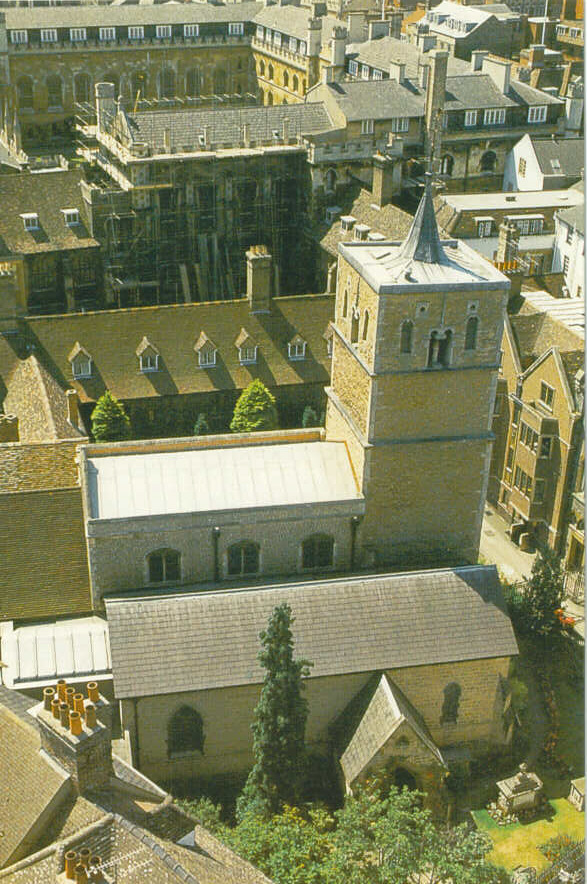 in Cambridge and has a long history
[currently missing from the church web page]. This page tells you something about the
bells.
in Cambridge and has a long history
[currently missing from the church web page]. This page tells you something about the
bells.
The church tower dates back to Saxon times and was probably
completed around 1033. It is
likely that it was built to contain bells from the beginning, however the
earliest record of bells in the tower dates to the 13th century when the
bell of the church was used to summon students to special lectures and to
examinations. The Rector,
Alan, complained about this in 1273, but was persuaded by Hugh de Balsham,
the Bishop of Ely, to permit the bell to be used 'in a civil and honest
way'. A condition was made
that the parish clerk should be satisfied for such ringing in the usual
manner, and an annual fee of 6s 8d was paid to him. It is likely that there was more than one bell in the tower so it
may have possessed a peal of four bells and the tenor was the best bell in
town.
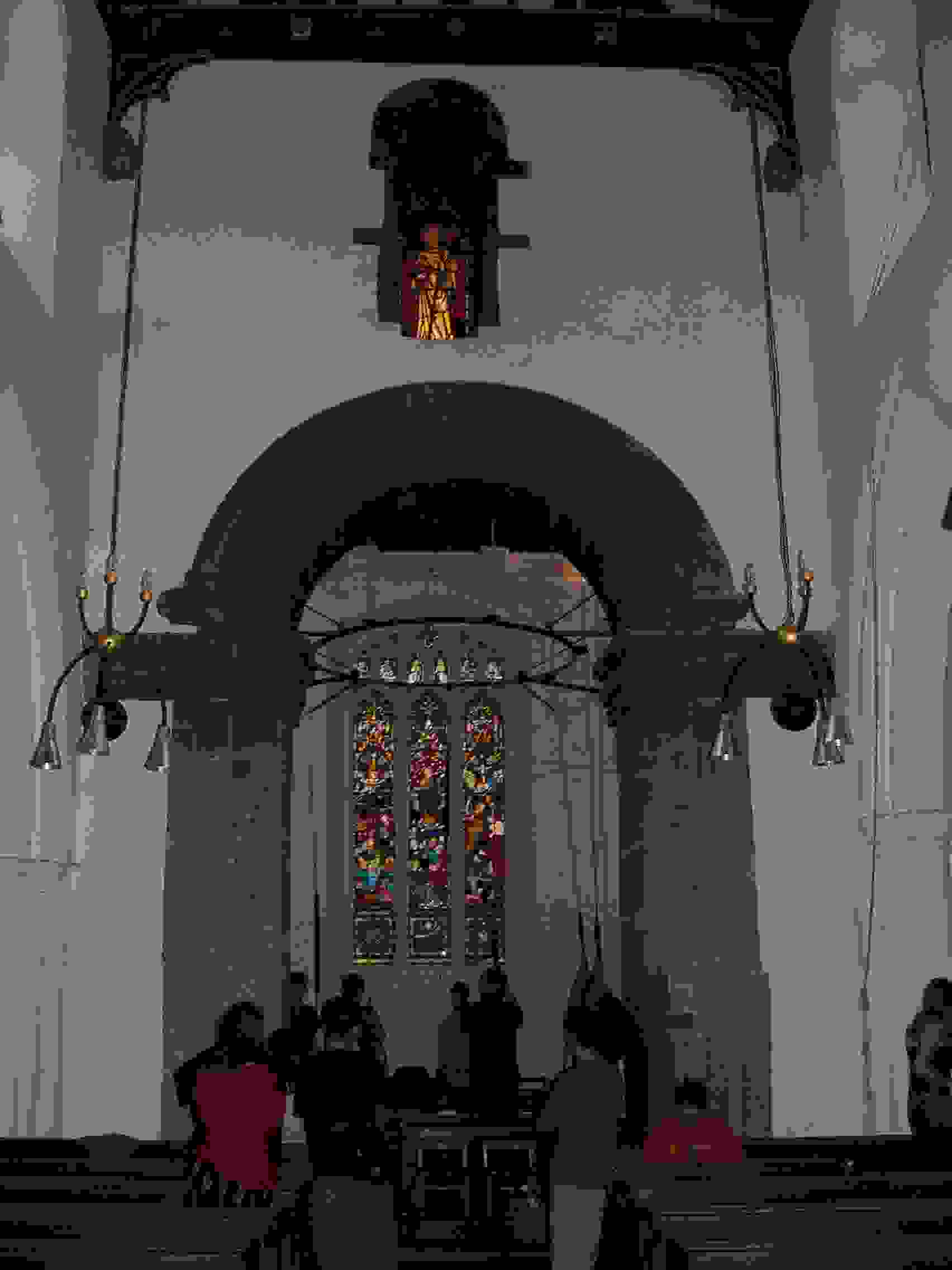 For many years after that, St Bene’t's bells were used for summoning
to 'ye schooles ... acts, clearums, congregations, lecturs, disses,
and such like' according to a receipt for the 6s 8d dated 1624.
In 1553 there were 'thre great Belles and one Sanctus Bell',
but by 1650 they were 'much out of frame and almost become uselesse'.
In 1655 the churchwardens appealed for money to repair the
bells. The University
gave thirty shillings, with the caveat that it was a free gift, not to
be regarded as setting a precedent.
Corpus Christi College also gave money. Although the tenor bell is dated 1618, the churchwarden,
Alexander Jacklin, was only born in 1605, suggesting that the bell is
actually a later recasting of a 1618 Draper bell and perhaps dates
from this time. Since
1660, the bells of Great St Mary's exclusively 'have been made use of
for Congregations, Clerums, Diput: &c:'. The ring of bells at St Bene’t’s was completed in 1663 when
the treble bell of the six was hung. Further work was carried out in 1725 when Thomas Newman of
Haddenham was paid £1. 10s. for casting brasses (bearings) for the
peal.
For many years after that, St Bene’t's bells were used for summoning
to 'ye schooles ... acts, clearums, congregations, lecturs, disses,
and such like' according to a receipt for the 6s 8d dated 1624.
In 1553 there were 'thre great Belles and one Sanctus Bell',
but by 1650 they were 'much out of frame and almost become uselesse'.
In 1655 the churchwardens appealed for money to repair the
bells. The University
gave thirty shillings, with the caveat that it was a free gift, not to
be regarded as setting a precedent.
Corpus Christi College also gave money. Although the tenor bell is dated 1618, the churchwarden,
Alexander Jacklin, was only born in 1605, suggesting that the bell is
actually a later recasting of a 1618 Draper bell and perhaps dates
from this time. Since
1660, the bells of Great St Mary's exclusively 'have been made use of
for Congregations, Clerums, Diput: &c:'. The ring of bells at St Bene’t’s was completed in 1663 when
the treble bell of the six was hung. Further work was carried out in 1725 when Thomas Newman of
Haddenham was paid £1. 10s. for casting brasses (bearings) for the
peal.
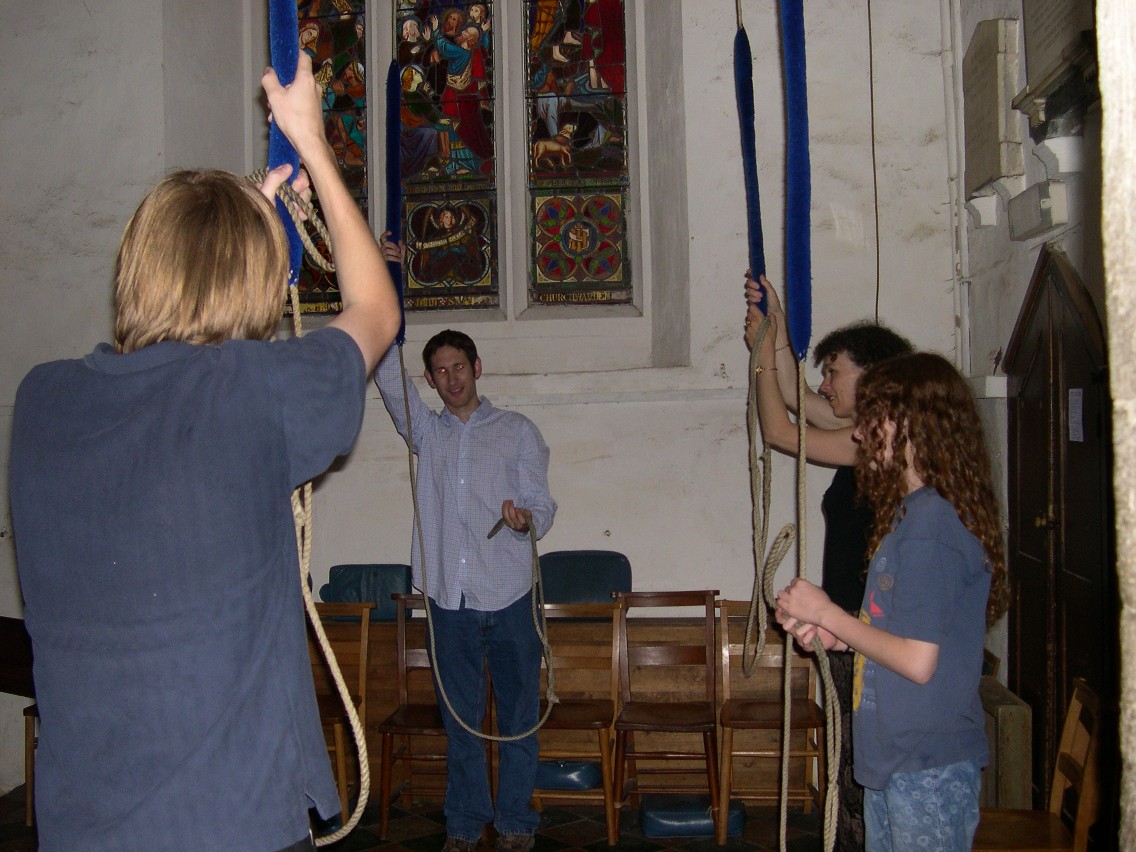 Traditionally St Bene’t's is associated with Fabian Stedman,
the inventor of English change-ringing in the 17th century.
Our Stedman was born in 1631 and was a parish clerk of the church in
1670, following the 1655 restoration, before moving to London in his trade
as a printer. The restoration
in 1932 was associated with the tercentenary of his birth.
A plaque on the north wall of the tower records that the restoration
was, 'paid for by the bell-ringers of England in commemoration of the
tercentenary of the birth of Fabian Stedman, founder of change ringing'.
Modern studies suggest that the Fabian Stedman who founded
change-ringing was actually born in Yarkhill, Herefordshire in 1640 and was
apprenticed to a London printer in 1656.
He became a prominent London ringer and died in 1713.
Traditionally St Bene’t's is associated with Fabian Stedman,
the inventor of English change-ringing in the 17th century.
Our Stedman was born in 1631 and was a parish clerk of the church in
1670, following the 1655 restoration, before moving to London in his trade
as a printer. The restoration
in 1932 was associated with the tercentenary of his birth.
A plaque on the north wall of the tower records that the restoration
was, 'paid for by the bell-ringers of England in commemoration of the
tercentenary of the birth of Fabian Stedman, founder of change ringing'.
Modern studies suggest that the Fabian Stedman who founded
change-ringing was actually born in Yarkhill, Herefordshire in 1640 and was
apprenticed to a London printer in 1656.
He became a prominent London ringer and died in 1713.
A barely legible board high in the tower commemorates the
ringing in 1785 of a course of 720 Bob, giving the names of the ringers.
This was not a full peal, which consists of 5040 changes and takes
about three hours to complete. Forty
five such peals have been rung on the bells, some rung for pleasure, others
to commemorate a special event such as the retirement of a vicar, a wedding
or the passing away of a loved one.
In April, Mere's commemoration is held in the church and the
bells are specially rung for the service as it is the only one at which the
University Bellringer is requested to be present. The Parish Clerk
is also requested to be present (although this post no longer exists), and both he and the
University Bellringer are paid for attending, their fees being ijd
and iijd respectively.
The bells are regularly rung for Sunday morning service (9:00 to 9:50) and
sometimes a quarter peal is rung for the evening service.
They peal loudly for weddings and half-muffled for funerals.
Friday night is practice night, so if you would like to learn how to
ring, come along between 7:30 and 9:00 pm. Occasionally the
times of
ringing may change, so check for any changes before planning a visit.
Today there are still 6 bells in the tower:
|
Bell
|
Note
|
Weight
|
|
Date
|
Founder
|
| |
|
(cwt)
|
(Kg)
|
|
|
|
Tenor
|
F#
|
13-3- 3
|
626
|
1618
|
John Draper, Thetford
|
|
5th
|
G#
|
10-1- 0
|
465
|
1610
|
Richard Holdfeld, Cambridge
|
|
4th
|
A#
|
8-3- 0
|
397
|
1825
|
William Dobson, Downham Market
|
|
3rd
|
B
|
6-2- 0
|
295
|
1607
|
Richard Holdfeld
|
|
2nd
|
C#
|
5-1- 0
|
238
|
1588
|
Unknown
|
|
Treble
|
D#
|
3-3-14
|
180
|
1663
|
Robert Gurney, Bury St Edmunds
|
Bell Inscriptions:
|
Tenor |
JOHN
DRAPER MADE ME 1618 AS PLAINLY DOTH APEARE THIS BELL WAS BROAKE
AND CAST AGAINE WICH TIMES CHURCHWARDENS
WERE EDWARDE DICKSON FOR THE ONE WHO STODE CLOSE BY HIS TACKLIN
AND HE THAT WAS HIS PARTNER THEN WAS ALEXANDER JACKLIN
|
|
5th
|
NON NOMEN
FERO FICTI SED NOMEN BENEDICTI
|
|
4th
|
HENRY
MARSHALL JUNR & WILLIAM W HAYWARD
|
|
3rd
|
OF ALL THE
BELLS IN BENET I AM THE BEST, AND YET FOR MY CASTINGS THE PARISH
PAID LEST
|
|
2nd
|
1588
|
|
Treble
|
1663
ROBARD CURNEY MADE ME THOMAS GRAVES THO FOX CHRUTCHWAR
DENS
|
On the Treble bell, in addition to the other mis-spellings, the
B of ROBARD is reversed and the A inverted.
Tonally the 4th is the best bell and the 3rd the worst.
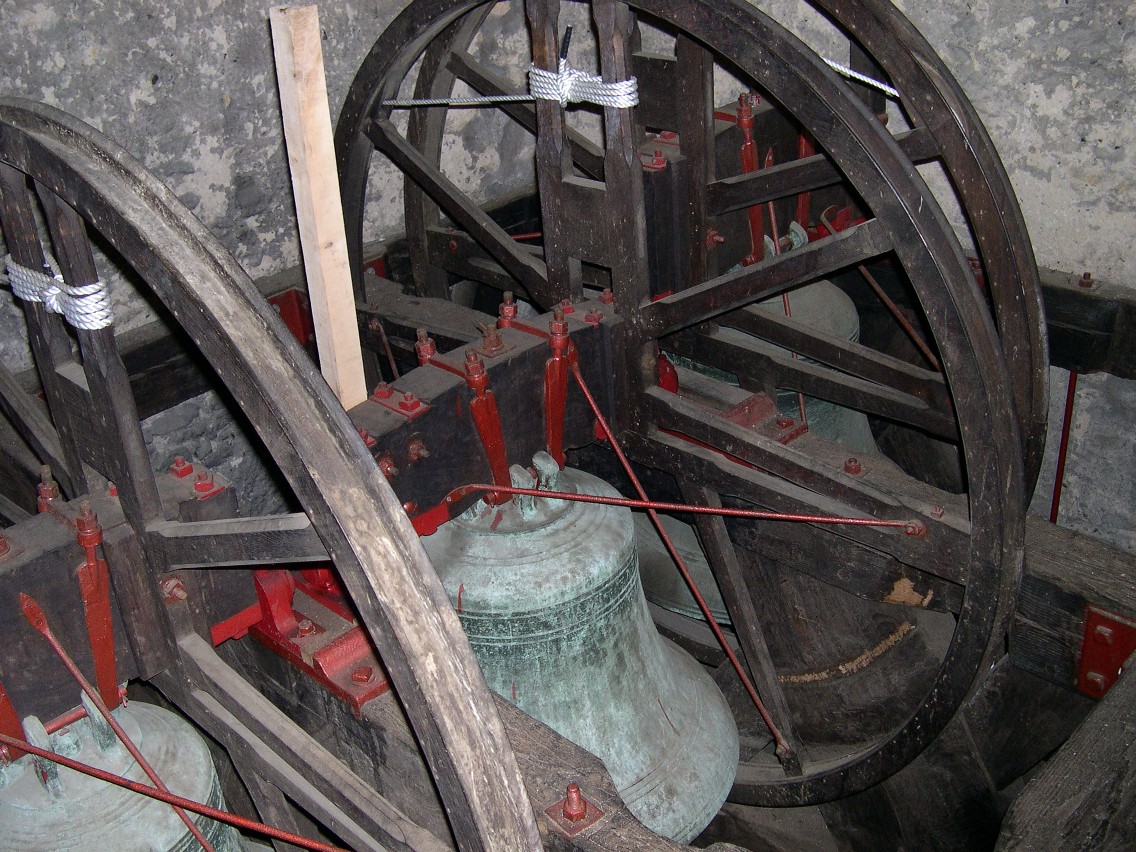
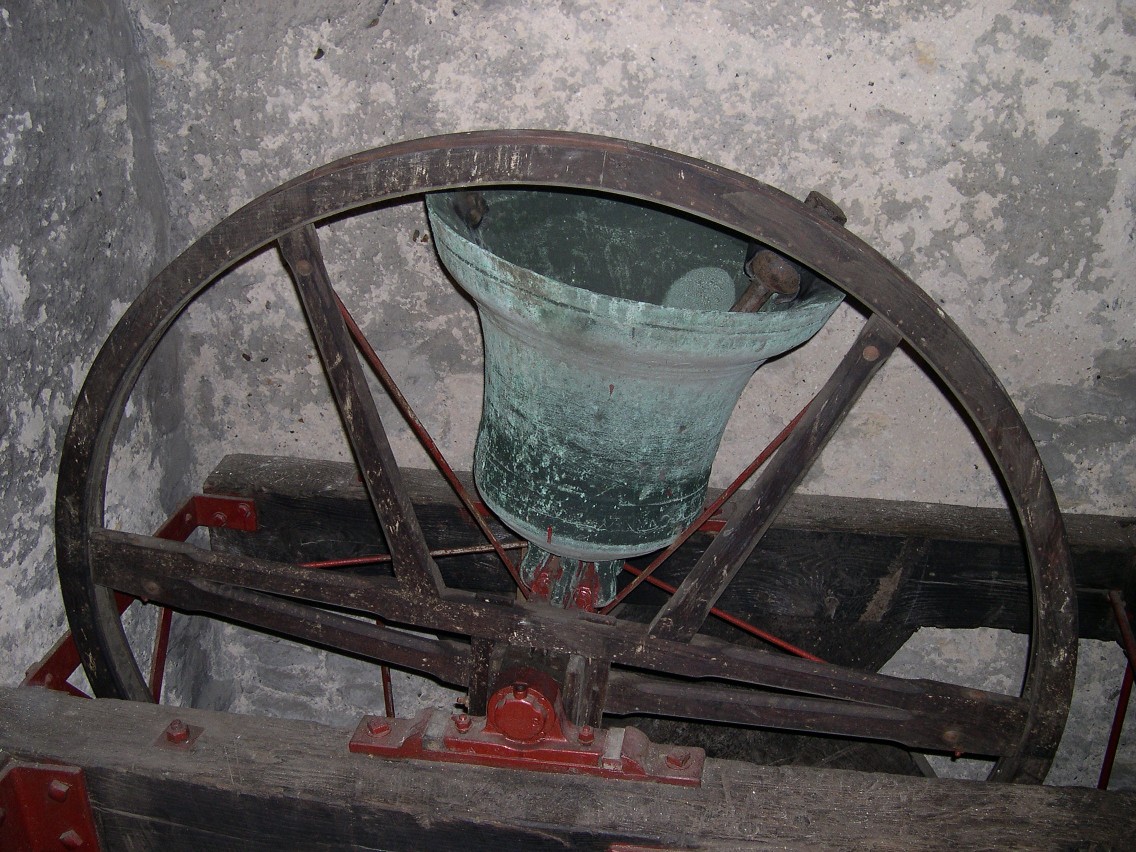
They all retain their canons (supporting loops) and are hung
on wooden headstocks, swinging on ball bearings.
The bell frame, made of wood, probably dates from the mid
17th century, though it was reconstructed and lowered some 10' in
the tower during restoration work in 1932.
It now sits on a modern concrete ring beam.
The present tower captain is Jonathan
Shanklin, who works for the
British Antarctic Survey as a meteorologist.
He looks after the bells, teaches learners and runs the ringing
out of the University term.
 During University term
the Assistant Master of the Cambridge University Guild of Change Ringers
runs the ringing. Catriona Shearer is the current Assistant Master. The
CUGCR or "Guild" also runs the ringing at Gt St Mary's at 5:30 on
Sunday evenings during term time. They have a practice at St Andrew's or
the Catholic church on Thursday evenings, and there is often a quarter peal
during Tuesday lunchtime at St Andrew's.
During University term
the Assistant Master of the Cambridge University Guild of Change Ringers
runs the ringing. Catriona Shearer is the current Assistant Master. The
CUGCR or "Guild" also runs the ringing at Gt St Mary's at 5:30 on
Sunday evenings during term time. They have a practice at St Andrew's or
the Catholic church on Thursday evenings, and there is often a quarter peal
during Tuesday lunchtime at St Andrew's.
St Bene't's is in the Cambridge
District of
the Ely Diocesan Association of bell ringers.
District meetings are held on the second Saturday of the month, and
are sometimes held at St Bene't's.
Other local practice nights are Gt St Mary's & Fen Ditton on
Monday night, St Edward's & Cherry Hinton on Tuesday night,
Trumpington on Wednesday night and Chesterton on Thursday night.
Sunday ringing is at 8:30 for Gt St Mary's, 8:50 at Cherry Hinton,
9:30 & 18:00 at Trumpington and 10:30 at St Edwards. Other
nearby churches may also ring on Sunday, although there is no Sunday
ringing at the Catholic or St Andrew's. Occasionally the
times of
ringing may change, so check for any changes before planning a visit.