
|
|
|
| [Science] [BAS home] [Met home] [Beowulf home] | Antarctic Meteorology |
Fri Jun 13 09:45:15 BST 2003 | jobsheet
b is like a, but with 10^-14.
Note that although the code above *claims* to alternately jigger values by +/- 1e-9, in fact due to an error all values are jiggered by +. However this doesn't appear to be a problem.
Yacfc is similar to this except I used 1e-5,6,7 (which all die rapidly with fpe err) then e-8 which is OK.
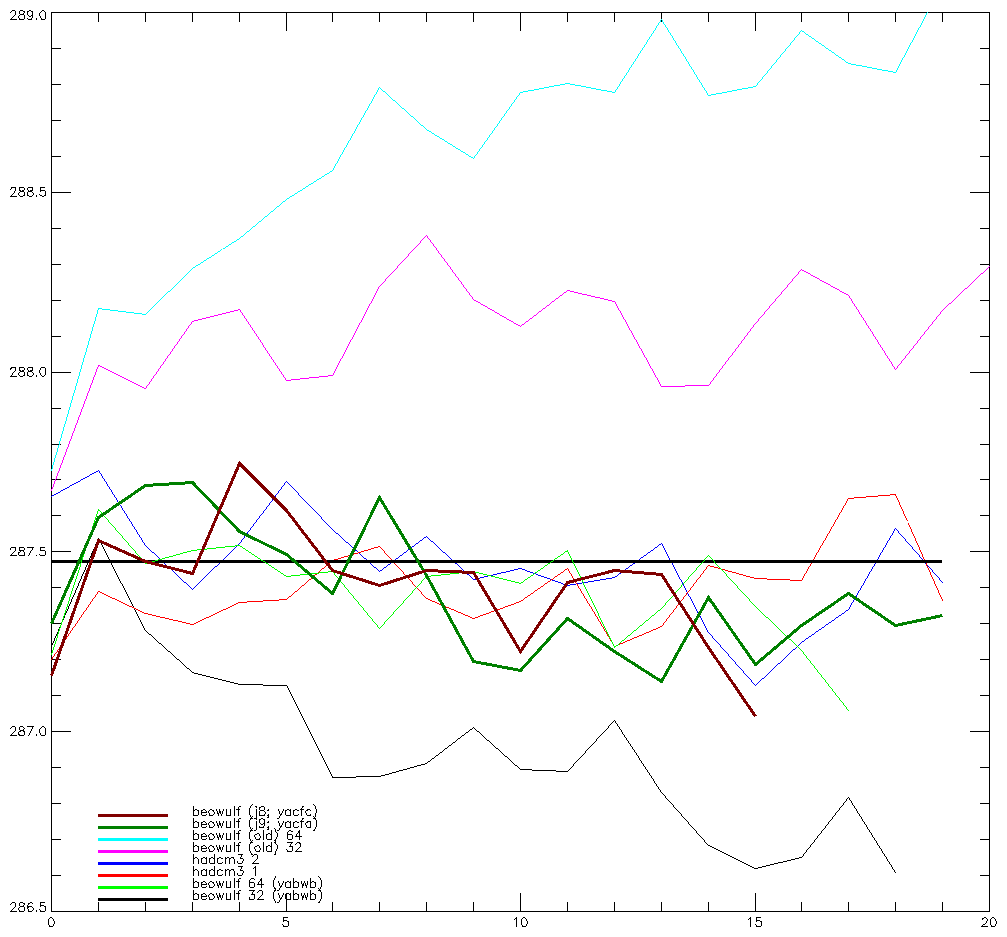
Summary: global annual T is OK at 64 bit but not at 32 bit; when looking zonally there appear to be problems with 64 bit too towards the poles; the "degrading" above doesn't degrade the results.
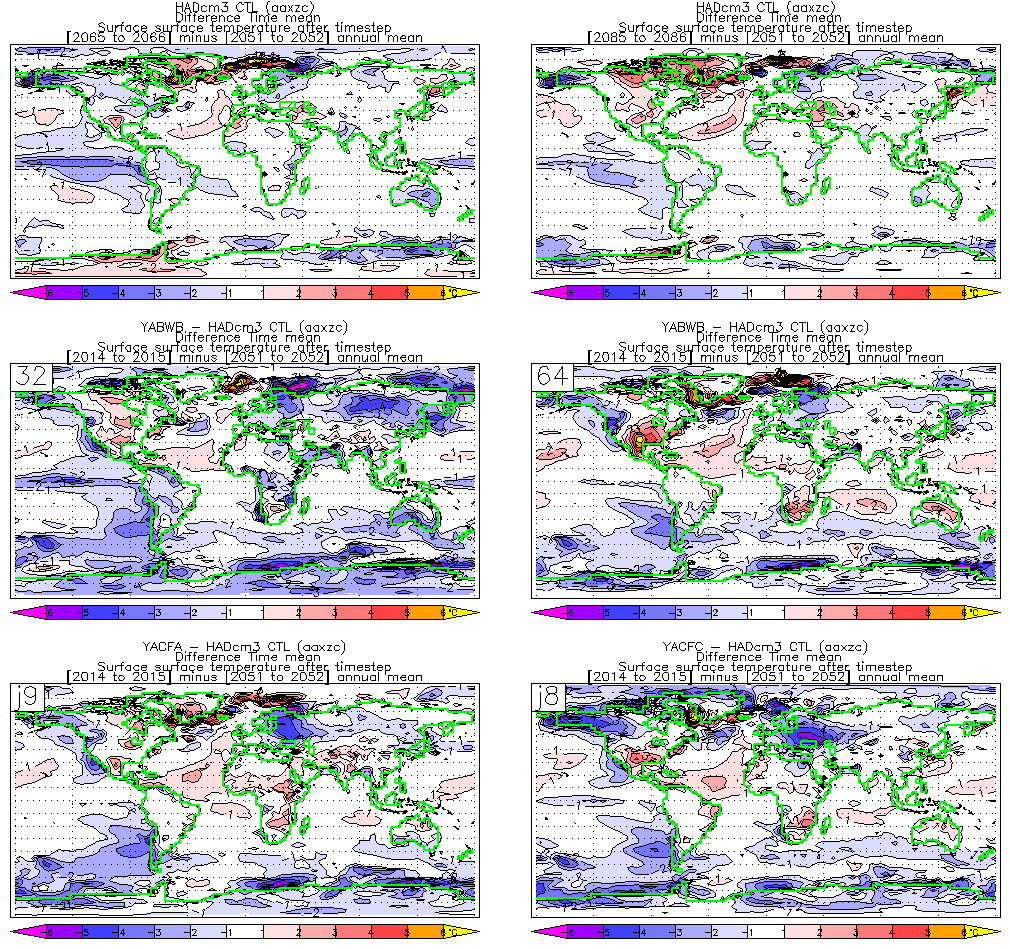
Now its somewhat less clear that things are OK, since its quite hard to distinguish 32 and 64 bit versions.
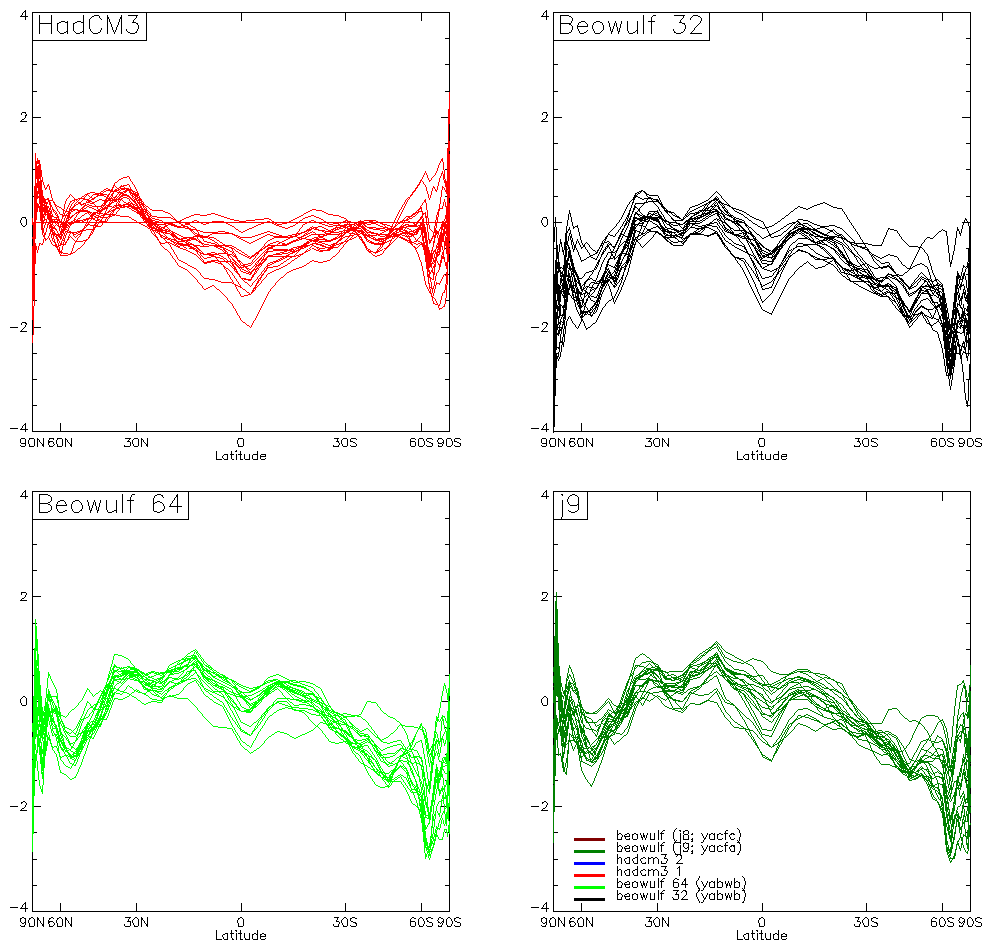
Notice: that hadcm3 diffs are always -ve in the tropics. Hadcm3 is known to be stable so this means that, most likely, the single year I've picked to diff against was a warm tropical year: this then biases all the results.
Notice: that the pattern of difference for the beowulf runs is quite characteristic (cooling in the polar-ish regions) and different from the inter-hadcm3 diffs. It isn't obvious from these pics that beowulf-32 is 0.8 oC globally cooler than beowulf-64 by year 15.
And now if we look at just yabwb (beowulf 64 bit) zonal means, in 15 year periods:
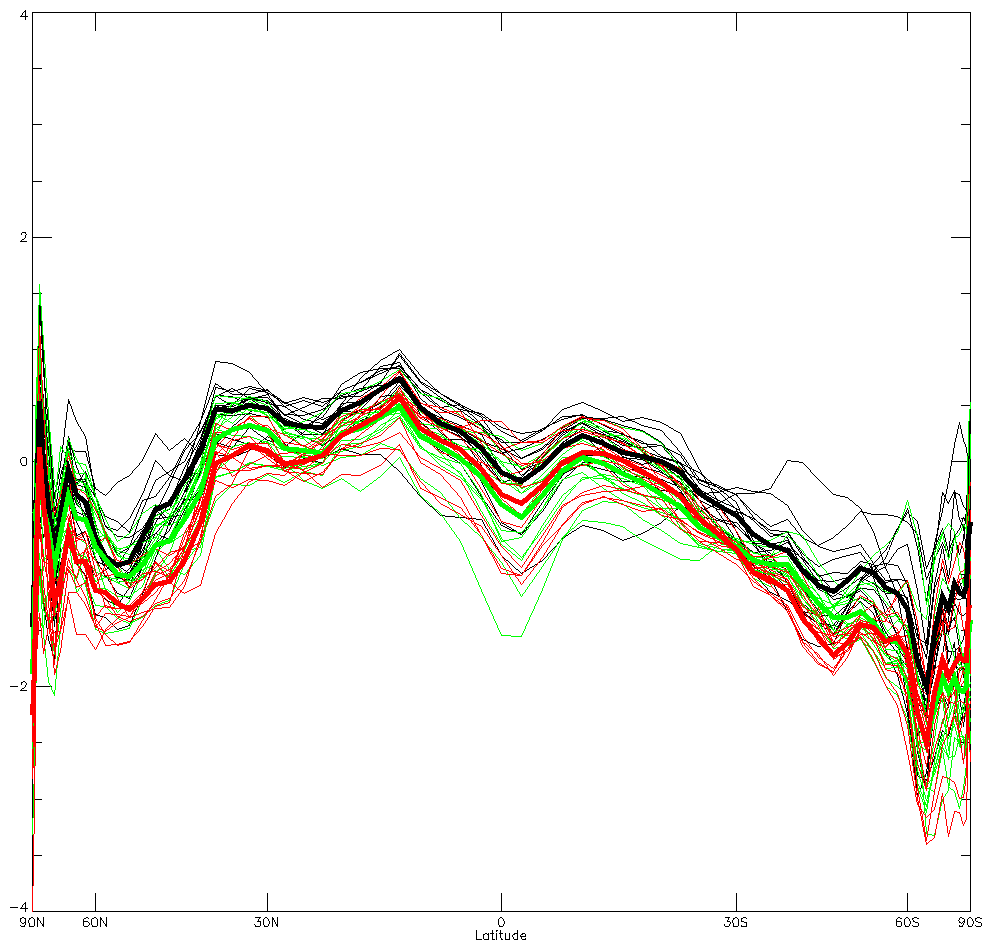
(thin lines: years; thick lines: 15 year averages; black: first 15; green; 16-30; red: 31-45 (actually
to 43...)).
| Past last modified: 4/8/2003 / wmc@bas.ac.uk |
© Copyright Natural Environment Research Council - British Antarctic Survey 2002 |