
|
|
|
| [Science] [BAS home] [Met home] [Beowulf home] | Antarctic Meteorology |
Note also: these are with correction to the level-by-level constants, *plus* fixes to the fourier routines. See yabba for without lbl and yabcc for lbl but no fourier fix.
Note that the IDL code is for my info for regeneration of the piccies.
; nb: picture at top right *is* ce-cc, even if not labelled as such!
@verify-pstar
gettwogifs,out='pstar_jja'
Produces:
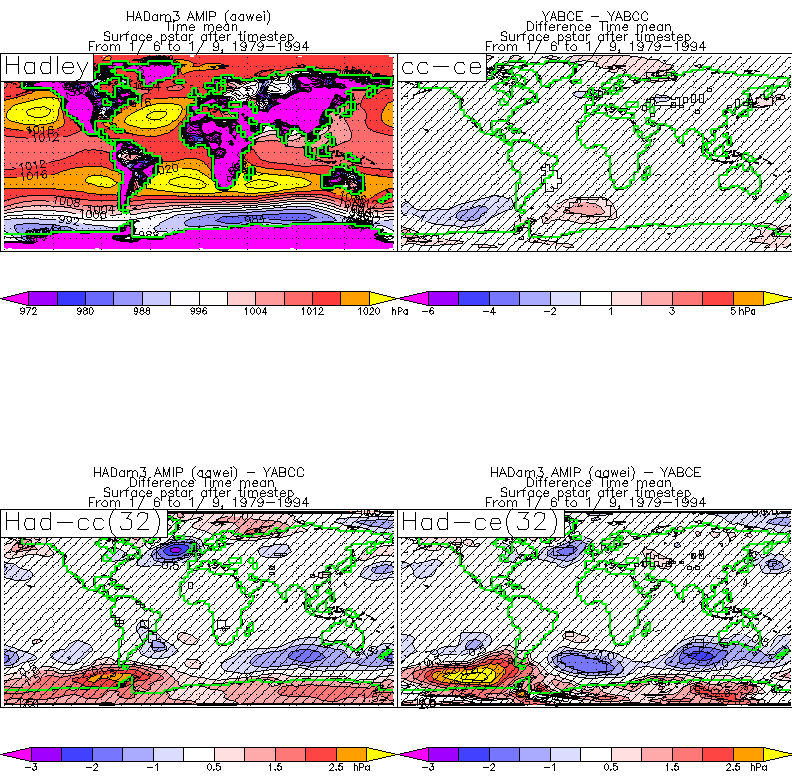
You see: TR: aawei. TL: yabcc - yabce (ie effects of including fourier mod). BR: aawei - yabcc. BL: aawei - yabce.
Note:
We see: adding the fourier mod appears to increase similarity to aawei (which, as pointed out by the wise WJI, is not what we should expect, since the fourier mod *isn't in* aawei. So I think we'll put it down to Variability until further studies shed more light).
Meanwhile, back in DJF:
m=12
@verify-pstar
gettwogifs,out='pstar_djf'
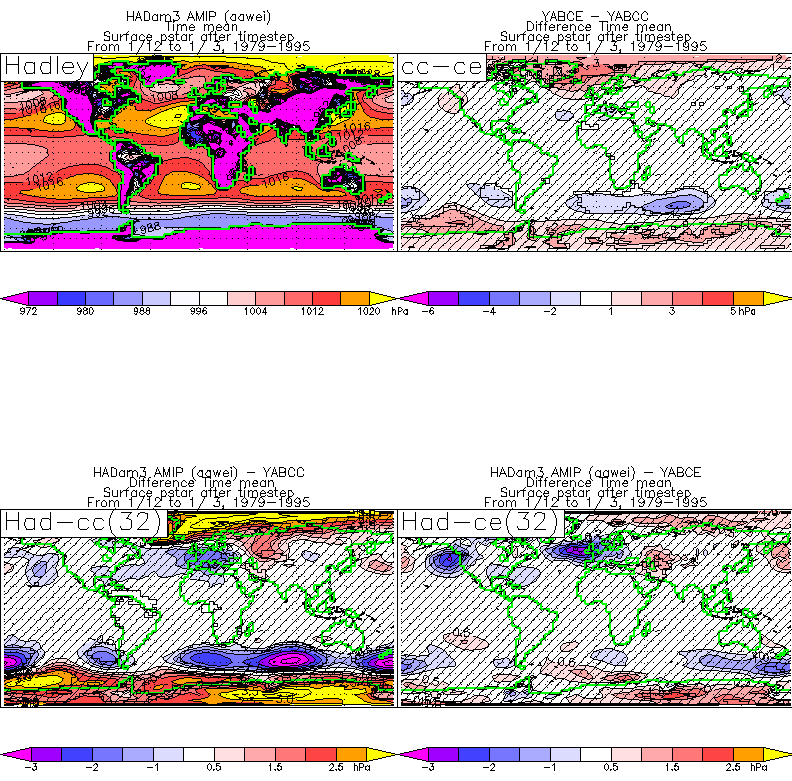
Once again, 32 and 64 bit are very similar. This time, its the NH that shows largest differences between them (winter hemisphere variance is always largest, so this could indicate that the difference is just variability).
Now, however, differences between yabcc and aawei are not huge, as they were in DJF in
yabba. Good. Is this chance, or because of fixing the
problem with the level by level constants? Note that its still worst in DJF... perhaps the flow is
intrinsically harder then?
| Past last modified: 1/5/2002 / wmc@bas.ac.uk |
© Copyright Natural Environment Research Council - British Antarctic Survey 2001 |